On November 1, 2026, NZZ am Sonntag, the Sunday edition of Switzerland’s Neue Zürcher Zeitung, published an in-depth feature on Patent™ Symbionic Teeth. The article encourages patients to learn about the latest developments in tooth replacement, look beyond short-term results and ask their dentist the right questions.
The main takeaway: long-term success in tooth replacement depends on the soft tissue. Here, we take a closer look at the main points.
Dental implants: the often-overlooked role of the soft tissue
For decades, dental implants have been the gold standard for replacing missing teeth. They are anchored in the jawbone and fitted with crowns to restore masticatory function. Whether the tissue around an implant stays healthy in the long term, however, is decided not in the bone but one level higher: in the soft tissue.
This is where dental implants have a structural shortcoming: while they are engineered to integrate into the jawbone, they typically keep their distance from the soft tissue. In the oral cavity, a warm and moist environment inhabited by up to 50 billion bacteria, this can become a problem:
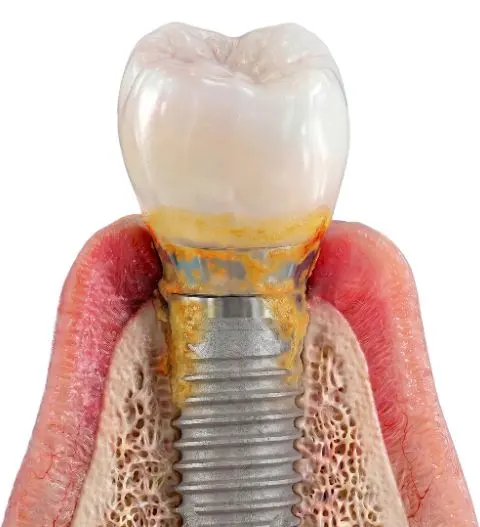
Without a connection between the implant surface and the soft tissue, a gap remains through which bacteria-harboring plaque can enter the deeper tissue layers and trigger tissue inflammation.
Two-thirds of implant patients affected
A review of studies shows how widespread the problem is: around two-thirds of patients with dental implants develop inflammation of the surrounding tissue (Derks & Tomasi 2015). More specifically, 43% develop mucositis, an inflammation of the soft tissue around the implant. If the inflammation spreads to the underlying bone, causing it to gradually recede, the condition is referred to as peri-implantitis. This chronic form affects around one in five patients.
Once lost, bone does not grow back. In severe cases, the implant may become loose and eventually need to be removed. What is particularly concerning is that this bone loss can progress for years without causing any pain. It is not necessarily a matter of poor oral hygiene. Toothbrushes and dental floss simply cannot reach the affected areas deep within the tissue.
The first symbionic tooth
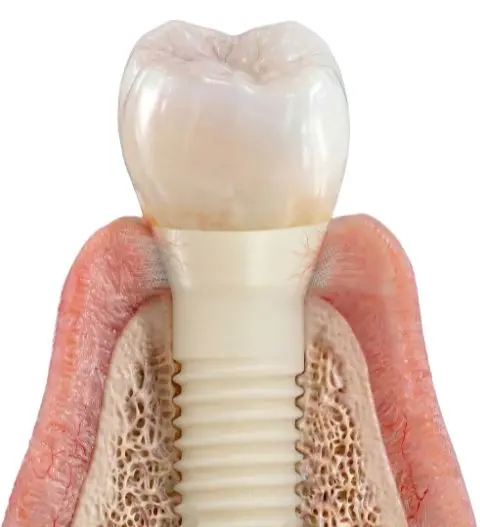
The first symbionic tooth represents a major paradigm shift. After years of research, it has become possible to develop tooth replacement that not only integrates with the jawbone but also forms a bond with the surrounding soft tissue – taking natural teeth as an inspiration.
This creates a biomechanical defense barrier that can keep plaque from migrating toward the bone, thereby reducing the risk of chronic inflammation. In this way, symbionic teeth build on the possibilities of dental implants. This medical breakthrough is made possible by a patented surface architecture.
Clinically documented over years
Independent research groups have followed patients with symbionic teeth (Patent™ Symbionic Teeth System) over extended periods, in a clinical cohort study over 9 years, conducted at the University of Düsseldorf (Brunello 2022), and a study with up to 12 years of follow-up, at the Medical University of Graz (Karapataki 2023). The Graz study also included patients with challenging initial conditions, including diabetes, smoking habits and a history of periodontitis. This makes the findings particularly relevant to everyday clinical practice.
Both studies have been published in peer-reviewed scientific journals. At the final examinations, both reported a peri-implantitis rate of 0%. The Graz study also found largely healthy soft tissue, while the Düsseldorf study reported long-term esthetic results, with an average recession of just 0.1 mm after nine years.
Discover Patent™ Symbionic Teeth
Are you looking to offer your patients with tooth loss a long-term solution and finding that dental implants have their limitations? Get in touch with Patent Medical AG. We will be happy to advise you on the possibilities of symbionic teeth and the benefits of their defense barrier for your patients.
Transparency notice: The feature published in NZZ am Sonntag on November 1, 2026, is an advertorial (Publireportage) produced on behalf of Patent Medical AG. Read the original article here (available in German only).